
INTRODUCTION
Life is a lot like a poker game
you are not always given the card you want . sometimes you get an amazing opportunity, while other times you have to work with limited information and limited circumstances . you cannot control every card you receive. but you can control how you respond to it
that is what makes poker psychology so intresting
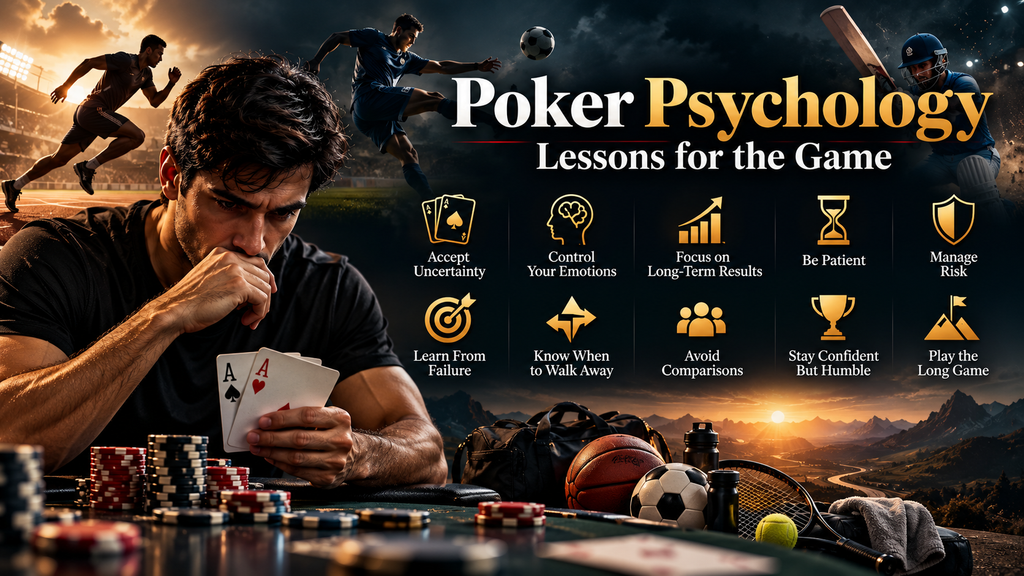
Poker is not only about cards or knowing rules. it also include decision making, emotional control, patience, confidence, risk management and resilience.
The goal is not to treat sports or life like gambling. Instead, poker can provide useful psychological lessons that athletes can apply to competition and everyday challenges.
1. You Cannot Control Every Card
One of the biggest lessons from poker is accepting uncertainty.
You can make a good decision and still get an unexpected result. The same thing happens in sports.
A cricket team can prepare perfectly and still lose because of changing conditions. A footballer can practice penalties for weeks and still miss an important shot.
The important question is not:
“Why did this happen?”
Instead, ask:
“What can I do now?”
Sports psychology Lesson is :-
Athletes should focus on controllable factors such as effort, preparation, concentration, and attitude rather than worrying about things they cannot control.
2. Good Decisions Can Still Produce Bad Results
Poker teaches an important distinction between decision quality and outcome.
You can make a sensible decision and still lose because the result is uncertain.
The same applies to athletes.
A basketball player may take a technically good shot that simply does not go in. That does not automatically mean the decision was wrong.
Instead of judging yourself only by the result, ask:
- Did I follow my strategy?
- Was I prepared?
- Did I make a reasonable decision?
- What can I improve?
Sports Psychology Lesson is:-
Learning to evaluate the process, rather than only the result, can help athletes develop resilience and reduce unnecessary self-criticism.
3. Control Your Emotions
A famous concept in poker is tilt. Tilt happens when emotions such as anger, frustration, or excitement start influencing decisions.
Athletes can experience the same thing.
Imagine a tennis player losing two easy points. Frustration builds, concentration drops, and the player starts rushing shots. The original mistake has now affected the next few points.
Poker Technique: Tilt Control
Pause → Breathe → Reset → Focus on the next action.
Sports Psychology Lesson is :-
Emotional control does not mean ignoring emotions. It means recognizing them without allowing them to control your behaviour.
6. Use Position and Information
Position is an important concept in poker because the order in which players act can influence the information available to them.
The broader lesson is:
Observe before you act.
A tennis player may observe an opponent’s movement before choosing where to place a shot.
A cricket bowler may study a batsman’s weaknesses before deciding how to bowl.
A footballer may observe an opponent’s positioning before making a pass.
Sports Psychology Lesson is :-
Better observation can lead to better decision-making. Athletes should avoid rushing into action when additional information can improve their response.
5. Know When to Fold
Folding is one of the basic techniques in poker. A player does not have to continue with every hand.
This teaches an important psychological lesson: sometimes continuing is not the best option.
In sports, this could mean changing a strategy when it clearly is not working.
For example, a football team may realize that repeatedly attacking through the middle is not working. Continuing with exactly the same approach simply because it was the original plan may not be productive.
Sports Psychology Lesson is :-
Being mentally strong does not mean stubbornly continuing. It means recognizing when to adapt, change strategy, or reset.
6. Manage Risk Instead of Avoiding It
Poker involves decisions under uncertainty. Players consider potential outcomes before choosing an action.
Athletes also constantly manage risk.
For example, a footballer deciding whether to attempt a difficult pass must consider the possible reward and the possibility of losing possession.
A cricket batsman deciding whether to play an aggressive shot faces a similar decision.
Poker Technique: Risk Assessment
Before taking a risk, consider:
- What could I gain?
- What could go wrong?
- Can I handle the consequence?
- Is there a safer alternative?
Sports Psychology Lesson is :-
Mental toughness is not about taking every risk. It is about making calculated decisions under pressure.
7. Build Confidence Without Becoming Overconfident
Confidence is essential in both poker and sports.
However, confidence can become overconfidence.
After several successful performances, an athlete may stop preparing properly or underestimate an opponent.
Healthy confidence sounds like:
“I trust my preparation, but I am still willing to learn.”
Sports Psychology Lesson is :-
Strong athlete confidence should be supported by preparation, practice, and self-awareness—not by believing that failure is impossible.
8. Stay Patient
Poker can teach the value of patience. Not every situation requires immediate action.
Athletes also need patience.
A young athlete may expect improvement after only a few weeks of training. When progress is slow, frustration can appear.
But athletic development takes time.
Sports Psychology Lesson is :-
Instead of focusing only on immediate results, athletes should focus on gradual improvement.
Ask:
“Am I better than I was yesterday?”
Small improvements can eventually create significant progress.
9. Play the Long Game
Perhaps the biggest lesson from poker psychology is to think beyond one moment.
One bad hand does not define a poker player.
One bad match does not define an athlete.
One failed attempt does not define your ability.
For athletes, a long-term mindset means focusing on development rather than allowing one competition to determine their confidence.
A runner may finish poorly in one race but use that experience to improve training.
A cricketer may have a poor season but identify weaknesses and return stronger.
Sports Psychology Lesson is :-
Resilience means recovering, learning, adapting, and continuing.
Final Thoughts
Poker psychology is not really about learning how to win at a card table. Its deeper lessons are about how people make decisions when faced with uncertainty, pressure, risk, and incomplete information.
Athletes experience these same challenges every day.
You cannot control every result.
You cannot prevent every mistake.
You cannot always predict what your opponent will do.
But you can control your preparation, emotions, attention, decisions, and response.
Accept uncertainty. Control your emotions. Manage risk. Learn from failure. Stay patient. Adapt when necessary.
And most importantly, remember:
One bad hand does not define the player—and one bad performance does not define the athlete.
The real goal is not to win every moment.
It is to keep improving your ability to handle the next one.